5 Tips for Your Resume

One of the most common editing requests I receive are for resumes. No matter what career path you’ve chosen or how long you’ve been in the industry, a solid resume can set you apart from other applicants for the better. 

How do you make a winning resume? Here are five simple tips to help. 

1. Use a template

A resume needs to visually grab the attention of the person sorting through a pile of job applications. Using a template is an easy way to achieve this, even if it’s just a template from Microsoft Word. If you’re a little more design-savvy, Canva is a user-friendly online design tool and the free version is great for getting a little fancy. More intermediate designers might go as far as to create their own template using Adobe InDesign.

Not sure if you’ve got the design skills to jazz up a resume yourself? Rest assured, there are professionals, including some editors, who can help make your resume pop.

2. But not just any template!

Think carefully about the role you’re applying for and the industry it falls under. Corporate? Keep it sleek and clean. Customer service? Make it energetic and approachable. Arts? Let your creativity shine.

Your resume should also reflect your level of experience. Some templates lend themselves towards lots of experience, but don’t look right if you don’t have enough to fill the page. Similarly, some templates are more suited for applicants with less experience, but look clunky and messy if too much is squeezed in.

At the end of the day, a resume is a professional document, which should be reflected in the final product. Be sensible with font and colour choices and remember that there is elegance in minimalism and simplicity.

3. Use relevant content 

The experience listed on your resume should reflect your industry. You’ve heard it a million times; your application for an accounting role doesn’t need to mention your year as a dish-pig at a pizza shop when you were in high school, or your short-lived stint as a glassy at The Swan Hotel. 

What if I don't have relevant experience_‘What if I don’t have relevant experience?’ Ah, I had a feeling you might ask. If you are applying for your first job, or if your past experience isn’t relevant to the job you’re applying for now, fear not. It happens. In these cases, the best thing you can do is highlight transferable skills. That year as a dish-pig when you were in high school might not have much to do with the marketing role you’re eyeing off, but working under pressure in a fast pace environment is one of many skills that transcends the bounds of industry. 

4. Use the right language

Resume-writing can feel stiff and stuffy at times, but it’s important to make sure the language is both formal and concise. If your language is too casual or informal, a potential employer may disregard your application. Furthermore, if someone is sorting through a pile of resumes, you need to get to the point fast. Using your words wisely will help to avoid a document that is too long or too cramped.

5. Proofread carefully

If ‘attention to detail’ or ‘excellent written communication skills’ are listed on your resume, don’t contradict yourself. Proofread your resume carefully before submitting it anywhere. In fact, you should ask somebody else to read it; preferably someone with a trained eye.

My sister once submitted her resume to the local bowls club after only letting our mother proofread it for her. She had written ‘bowels club’ instead of bowls club. Safe to say she didn’t get that job.

The safest option is to ask an editor to proofread your resume (and cover letter!) to make sure none of those pesky mistakes end up in your job application. 

Keep these helpful tips in mind to make your best resume yet. 


Need help with your resume? Bonnee Crawford Editing offers affordable resume proofreading services. Check out my portfolio to see how I can help, or ask for a quote today

Why Are There Different Types of Editing?

My last three posts have explained the differences between the three types of editing: content editing, copy editing, and proofreading. In these posts, I stressed the fact that each type of editing should be completed separately. But why is that? And why are they completed in such a particular order?

The main reason each level of editing ought to be completed separately is so the editor’s efforts are focused.

Another important reason for each stage of editing to be completed separately is to prevent double-ups from occurring. For example, if an editor completes copy editing before or alongside content editing, they’ll likely have to redo the task anyway. Content editing includes rewriting, rearranging, adding, and omitting text, which means if that text was copy edited already, all that hard work will be undone.

The separation of these tasks also means that an editor can focus on a specific set of elements without getting sidetracked. Editing structure and content takes a lot longer if the editor stops to think about every comma and dash along the way. Keeping the stages of editing separate makes it easier to do each job thoroughly, because the editor isn’t trying to do too many things at once.

Another reason the three stages happen in this order is that, once a piece of work has been put in the design file, making changes like adding or removing words creates a lot more work for the designer than you might think. Keeping the stages separate ensures that each level of editing is completed thoroughly, without distraction, to minimise having to redo tedious work.

Types of Editing: Proofreading

An infographic about proofreading with dot-point examples. Editing for publication. Final stage of editing before printing or publication. Check design for legibility, layout issues and appropriate use of fonts, colours and images. Check formatting (e.g. bold, italics) against the copy edited version. Ensure all content is present—check for missing words, sentences and paragraphs. Check that the design brief has been followed. Ensure content is attributed to the correct author. Ensure pages are in the correct order and page numbers match on the contents page.  Last chance to fix typos and any other mistakes. These are general examples and not a complete list.

In my last two posts, I talked about content editing and copy editing, which are the first two stages in the editing process.

This post will summarise what happens in the final stage of editing: proofreading.

What is proofreading?

Proofreading occurs after the writing has been typeset and formatted in a design file. The design file will place the text alongside any other content (e.g., images, tables and figures, contents page) to appear in the final publication.

Nowadays, proofreading will usually happen digitally using a PDF of the publication-to-be. If the text is being published on a blog or forum—like this post—proofreading can be done in ‘Preview’ mode.

The aim of proofreading is to ensure legibility, resolve page layout issues, and check that design choices are appropriate. Once text is in a design file, it becomes a lot harder to make substantial changes. Major changes at this stage could alter the page count or require a rework of the layout to make everything fit again, which can be time-consuming and expensive. So, what does a proofreader do?

What happens during proofreading?

The author is not usually involved in the proofreading stage of the editing process, unless they are also the designer or liaising with the designer on the proofreader’s behalf. A proofreader will review the document with attention to aspects of design and page layout. This task encompasses a myriad of things, from making sure the font is legible against the background, to ensuring only high-resolution images have been included.

Proofreading also checks that the design brief has been followed. For example, the brief might specify that new paragraphs are to be shown by leaving a blank line, text is to be aligned left and justified, and page numbers are to appear in the top-left header of each page in hot pink 8pt Century Gothic font. Proofreading checks that all of these instructions have been applied consistently.

Another important part of proofreading is cross-checking the proof pages with the copy-edited version to ensure formatting (e.g., use of bold and italics, superscript) hasn’t been lost, and to make sure no text has gone missing or been included twice. Proofreading is also the absolute last chance to catch sneaky typos that might have been overlooked during copy editing.

At the end of the proofreading process, the editor will provide the designer (or the project editor or author) with a list of proofreading notes, or a file with proofreading markup. The notes or markup will then be applied to the design file by the designer.


Attention to detail is paramount in this final stage of the editing process. While web copy can be more forgiving, once a text is sent to print or a digital file is made available, it’s too late to make corrections. For best results, ensure your proofreader is given sufficient time to complete their task thoroughly.

Types of Editing: Copy Editing

An infographic about copy editing with dot-point examples. Image text: Copy Editing. Working at the sentence level. Editor works independently and only engages author if required for clarification. Spelling conventions and consistency. Grammar and usage (e.g. tenses). Syntax and sentence structure. Vocabulary. Punctuation. Formatting (e.g. dates, times, use of bold and italics). Other stylistic choices (e.g. numbers presented as numerals or spelled out as words). These are general examples and not a complete list.

In my previous post, I gave an overview of the first stage of editing, which focuses on improving the overall structure and content of written work.

This post will provide a similar overview to the second stage of the editing process: copy editing.

What is copy editing?

Copy editing occurs once all significant structural changes to the writing have been applied and finalised. You can think of copy editing as a way of ‘cleaning up’ the writing itself by honing in on the sentence level. A copy editor will pay close attention to the mechanics of the text (e.g., spelling, grammar, punctuation), stylistic consistency (e.g., words with variable spellings, presentation of numbers and measurements), and elements that affect readability (e.g., wordiness and the nuance of word choices).  

What happens during copy editing?

A copy editor can work independently from the author (or publisher) after they have been briefed. A copy-editing brief might include the provision of an existing house style and/or spelling sheet if decisions have already been made (e.g., whether to use single or double quotation marks). The copy editor may contact the writer or publisher to clarify preferences that were not already specified. Personally, I prefer to use tracked changes when copy editing so that the author can review the corrections.

The copy editors will build on the spelling sheet if one was provided, or create one if not. This is where they will record decisions and create a point of reference for things like words and names with unique or variable spelling, and other decisions that have been applied or made consistent in the text. In addition to the spelling sheet and aforementioned house style, an editor should also have a dictionary and thesaurus. Depending on the type of writing, an editor might also need a referencing guide or a specialised dictionary for a specific subject. These resources help copy editors work efficiently and effectively to perfect every word on the page.


When any form of writing is being edited for publication, copy editing is the last chance to ensure everything is correct before the text is sent to the designer. Once the writing has been placed into a design file and typeset, it becomes harder to make changes without undoing somebody else’s hard work. While copy editing is not the final stage in the editing process, it is an integral step and should be done with diligence.

Types of Editing: Content Editing

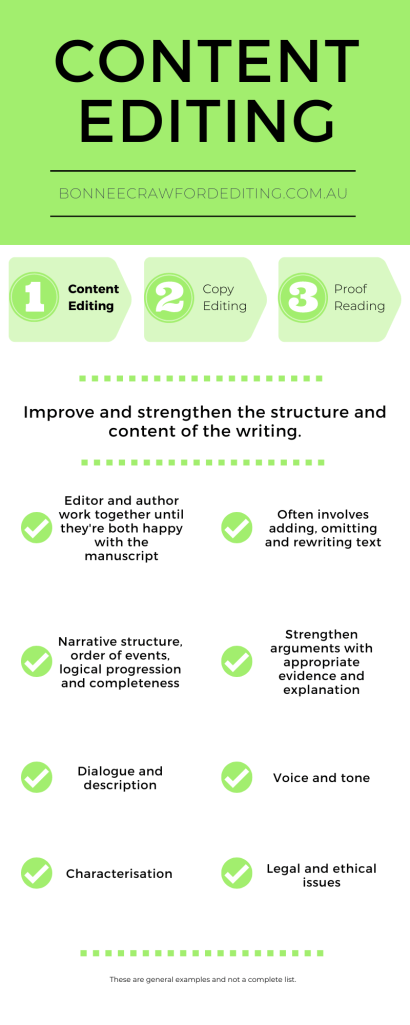
An infographic about Content Editing with dot-point examples. Image text: Content editing. Improve and strengthen the structure and content of the writing. Editor and author work together until they're both happy with the manuscript. Often involves adding, omitting and rewriting text. Narrative structure, order of events, local progression and completeness. Strengthen arguments with appropriate evidence and explanation. Dialogue and description. Voice and tone. Characterisation. Legal and ethical issues. These are general examples and not a complete list.

Editing is so much more than correcting spelling and grammar. In fact, there is a whole stage of editing that comes first.

Before an editor worries about typos, they will help you get your writing to a stage where it won’t require substantive changes. To do that, they’ll begin the editing process with content editing.

What is content editing?

Content editing—sometimes called structural editing—is the first stage of editing your work should undergo. This is when an editor works closely with an author to improve the overall content and structure of a piece of writing.

An easy way to work out what happens at this stage is to consider the name; this level of editing focuses on the content and the structure of the writing. Put simply, the aim of content editing is to strengthen arguments, develop the style and voice, and make sure the work flows logically.

What happens during content editing?

During the content editing or structural editing stage, an editor provides constructive feedback to help guide the author in making changes that strengthen their writing. This process often includes rewriting and rearranging paragraphs, adding to the manuscript, and removing unnecessary sections.

An editor will also be on the lookout for potential ethical and legal issues at this early stage. If an editor finds anything of concern, they will help the author navigate the problem.

The specifics of what happens during content editing will vary depending on the type of writing. The examples below are just the tip of the iceberg. I’ll talk more about content editing for specific writing forms in later posts.

Creative writing

For creative writing, content editing includes improving characterisation, perfecting dialogue, and eradicating plot holes. An editor can work with you to make your story more compelling and harder to put down.

Academic writing

Academic writers will usually work with someone familiar with their subject area at this stage of editing. Content editing can include checking that arguments and assertions make sense, are well-structured, and are appropriately supported through citations and other evidence.

Technical writing

For technical writing, content editing includes keeping the tone professional and ensuring all required information is included and accurate.


The focus on major changes during this stage is crucial. Correcting spelling, grammar, and punctuation is secondary until content/structural editing is complete.

Are you ready to begin content editing with your writing?